B2B rebranding: what it means and how to get it right
A merger, a carve-out, a new market, a new strategy – any of them can leave the brand out of step with the business. But not every change calls for a full rebrand. This guide covers how to tell a rebrand from a refresh or a repositioning, what the process involves from business case to launch, and how three B2B companies went through it.
What is B2B rebranding? B2B rebranding is the strategic process of changing how buyers, employees, investors and partners perceive a company, not just how it looks. It realigns positioning, value proposition, messaging and visual identity with where the business and its market are heading, so everyone in the buying centre understands the value on offer and can choose with confidence.
What’s in this guide
- Why do B2B brands fall out of step with the business?
- Is rebranding just a new logo?
- What does rebranding mean in B2B?
- When is it time to rebrand?
- Rebrand, refresh or repositioning: which do you need?
- Why B2B rebranding needs a different approach
- Why words can mean more than visuals
- How does the B2B rebranding process work?
- Building the business case for a rebrand
- How long does a rebrand take, and what does it cost?
- Common misconceptions about rebranding
- Rebranding in practice
- Frequently asked questions
Why do B2B brands fall out of step with the business?
B2B brands fall behind when the business or its market moves on and the brand doesn’t. Sometimes your business changes: new markets, new capabilities, perhaps a merger. Sometimes the world around it does: buyers research differently, competitors redraw the map, and technology, regulation and sustainability demands shift what customers expect. Either way, your brand can end up telling yesterday’s story. Buyers notice the gap. Your sales team spends meetings explaining it. And competitors with a clearer story earn trust first.
Is rebranding just a new logo?
For most people, the idea of rebranding goes no further than a shiny new logo, updated colour schemes, or a fresh tagline. Sure, these visual elements are usually an essential part of the process, but genuine rebranding is far more comprehensive.
For businesses, especially in the B2B sector, rebranding involves reshaping perceptions, redefining values and aligning every facet of the organisation with its long-term goals.
More B2B insights: An insider’s guide to successful B2B branding
What does rebranding mean in B2B?
In B2B, what a rebrand has to change goes deeper than in consumer markets. Buying decisions are made by groups, not individuals: engineers, procurement, finance and management all need to understand why you’re the safer choice. A rebrand that only changes the surface gives none of them a better reason to say yes. Key elements of a rebrand include:
- Repositioning the brand in the market
- Refining or re-articulating the mission, vision and values
- Adjusting messaging and tone of voice to align with target audiences
- Enhancing internal culture to strengthen employee alignment and engagement
- Improving customer and stakeholder relationships
When is it time to rebrand?
A rebrand pays off when it reflects a real shift in the business or its market. The trigger can come from inside the business or from the market around it. These are the situations where we most often see B2B companies outgrow their brand:
- After a merger or acquisition. Two cultures, two stories and often two sets of customers who need one clear reason to stay. Why rebranding should lead, not lag, in M&A success
- When part of the business is spun out or divested. A carved-out company needs an identity of its own, often including a new name, while keeping what customers already valued about it.
- When you enter new markets or sectors. A brand built for one home market rarely travels well without being rethought.
- When your offering has outgrown your story. You now sell solutions, services or expertise, but buyers still see the product company you used to be. Ørsted’s shift from fossil fuels to renewables is the clearest case: a new name and story followed a genuine change in what the business did.
- When you look and sound like your competitors. If buyers can’t tell you apart, they default to price.
- When a portfolio of names confuses buyers. Sub-brands and legacy names that made sense once can now slow down decision making.
- When trust needs rebuilding. Rebuilding trust takes authentic communication, operational changes and a clear demonstration of values.
- When your market shifts around you. New competitors, consolidation, regulation or technology can change what buyers value, and a brand that once fit can quietly stop fitting. IBM is the obvious example: as enterprise customers moved from buying hardware to buying services, IBM had to change how it was seen.
- When the way your customers buy changes. Buyers now form a view of you across many channels long before they speak to sales, so an unclear or inconsistent brand costs you before you know you’re in the running.
Rebrand, refresh or repositioning: which do you need?
Not every brand problem calls for a full rebrand. Choosing the right scope saves time and budget, and avoids changing what buyers already value.
| Brand refresh | Repositioning | Rebrand | |
|---|---|---|---|
| What changes | Look and feel; strategy and name stay | What you stand for and where you compete | Positioning, story and identity together, sometimes the name |
| Typical trigger | Dated or inconsistent identity | New segment, new competition, new offering | Merger, new strategy, brand no longer fits the business |
| Risk of choosing wrongly | A nicer look, the same problem | A strategy buyers can’t see | A costly change without a clear reason |
Why B2B rebranding needs a different approach
B2B brands are bought over months, by committees, on trust. That changes what a rebrand has to do. It has to give every stakeholder in the buying centre a reason that makes sense to them, and it has to give your sales team a story they can use in the next meeting, not just a new slide template.
Changing perceptions requires alignment among all stakeholders, including employees, customers and partners. That takes clear communication, engagement and often a shift in company culture. So the place to start is on the frontline: the workforce.
Employees are the first ambassadors of a brand. A successful brand transformation involves educating and engaging employees to ensure they understand and embody the new brand. If your rebrand doesn’t engage internal teams, then it’s also likely to fall flat with external audiences.
More B2B insights: B2B vs B2C rebranding: what’s the difference and why it matters
Why words can mean more than visuals
Messaging and storytelling are the real drivers of how a brand is perceived. Rebranding involves redefining how a company communicates its value proposition, narrative and personality. Strong messaging resonates with target audiences and differentiates the brand from competitors.
How does the B2B rebranding process work?
A rebrand that lasts follows the order buyers experience it in reverse: get the thinking right first, then the words, then the look.
- Build the business case and map your stakeholders. Agree what the rebrand must achieve commercially, and who inside and outside the business needs to be on board.
- Listen before you decide. Gather input from customers and stakeholders through surveys, focus groups and interviews, and audit how your brand is perceived today. Their insights can inform the rebranding process and foster buy-in.
- Define your positioning and brand strategy. Develop a clear strategy that outlines the purpose of the rebrand, the audience it serves and the goals it aims to achieve. Align this strategy with the company’s broader business objectives.
- Revisit mission, vision and values. Revisit and refine these foundational elements to ensure they align with the company’s current direction. Make them a central part of the rebranding narrative.
- Shape messaging, tone of voice and identity. Redefine how the brand communicates with its audience. Messaging should be clear, authentic and aligned with the brand’s personality.
- Bring your people with you. Involve employees in the rebranding process and provide training to ensure they understand and embody the new brand.
- Launch across every touchpoint. A successful rebrand requires a coordinated rollout across all touchpoints – website, marketing materials, social media, physical locations and more.
- Measure what changes. Track awareness, perception and pipeline against the baseline you set in step 2, so you can show the rebrand is paying off.
More B2B insights: From buy-in to buzz: five steps to a successful B2B rebrand launch
Building the business case for a rebrand
Rebrands are approved in the boardroom, so they need to be argued in boardroom terms. The strongest business cases link the rebrand to a commercial goal (entering a market, integrating an acquisition, winning larger contracts) and show what it costs to keep a brand that no longer fits. A short decision paper for the C-suite, covering the problem, the options, the investment and how success will be measured, is often what turns ‘nice to have’ into ‘go’.
How long does a rebrand take, and what does it cost?
It depends less on design and more on scope. The main drivers are: how many markets and languages are involved; whether brands or sub-brands are being merged; whether the name changes, which adds legal and trademark checks; how much research is needed; and how many touchpoints need updating, from website and sales material to product documentation, signage and trade show stands.
Common misconceptions about rebranding
- ‘Rebranding is just a logo redesign.’ As this post illustrates, a logo is just the tip of the iceberg. True rebranding involves strategic, cultural and operational changes.
- ‘Rebranding can fix everything’. While a brand transformation can address specific challenges, it’s not a cure-all. For example, operational inefficiencies or poor customer service cannot be resolved through branding alone:
- ‘Rebranding is a one-time event.’ Rebranding is an ongoing process that requires regular re-evaluation and adaptation to stay relevant.
- ‘Rebranding means losing what buyers already recognise.’ Keep the equity that works: a name, a colour, a reputation for reliability.
- ‘Rebranding means losing search visibility.’ A new name or new website can reset years of rankings unless redirects and content are planned from the start.
Rebranding in practice
Rebranding can be triggered by very different circumstances. These three started with an acquisition, a carve-out, and a business that had outgrown its own story.
OSCAR – from product brand to corporate brand after an acquisition
The challenge. When the Solina Group acquired OSCAR, a product brand known to professional kitchens had to become a corporate brand covering both OSCAR and Puljonki. The shift had to happen without losing the equity OSCAR had built with chefs, and it needed a brand architecture clear enough to work across markets and channels.
The solution. CBC built the positioning on insight from professional kitchens: it presents OSCAR as a way for chefs to keep control of their cooking rather than a shortcut, respecting the craft while supporting consistency. That thinking produced the tagline Own the taste, along with a visual identity, corporate brand guidelines and templates designed to scale.
Airnord – from division to independent brand
The challenge. Airnord was born from FLSmidth Airtech, FLSmidth’s Air Pollution Control division, carrying nearly a century of technical heritage but entering the market as a new standalone entity. The balancing act: create visibility and momentum for a new brand, while reassuring customers, partners and employees that the expertise, presence, people and technology remained unchanged. The brand had to signal independence without suggesting disruption – evolution, not rupture.
The solution. CBC began with deep strategic and positioning work, defining Airnord’s market narrative and long-term ambition, then created the name, verbal identity and visual universe. From there came a full launch ecosystem, from website and launch video to press materials, event design and sales enablement tools, so every touchpoint reinforced both renewal and continuity.
‘When the Air Pollution Control business was divested from FLSmidth, we needed a clear identity for the new company. CBC quickly understood our business challenges and helped turn that insight into the Airnord name and brand – building on our heritage while giving Airnord a strong independent identity.’
Bjarke Ove Andersen, CTO, Airnord
Silverstream Technologies – from technology leader to impact leader
The challenge. Silverstream had grown into a global leader in air lubrication for ships, but its identity still spoke the language of the technology rather than of what it delivers. Customers were increasingly asking for evidence of commercial value, operational efficiency and regulatory compliance, and the brand had not kept pace with the company’s commercial maturity.
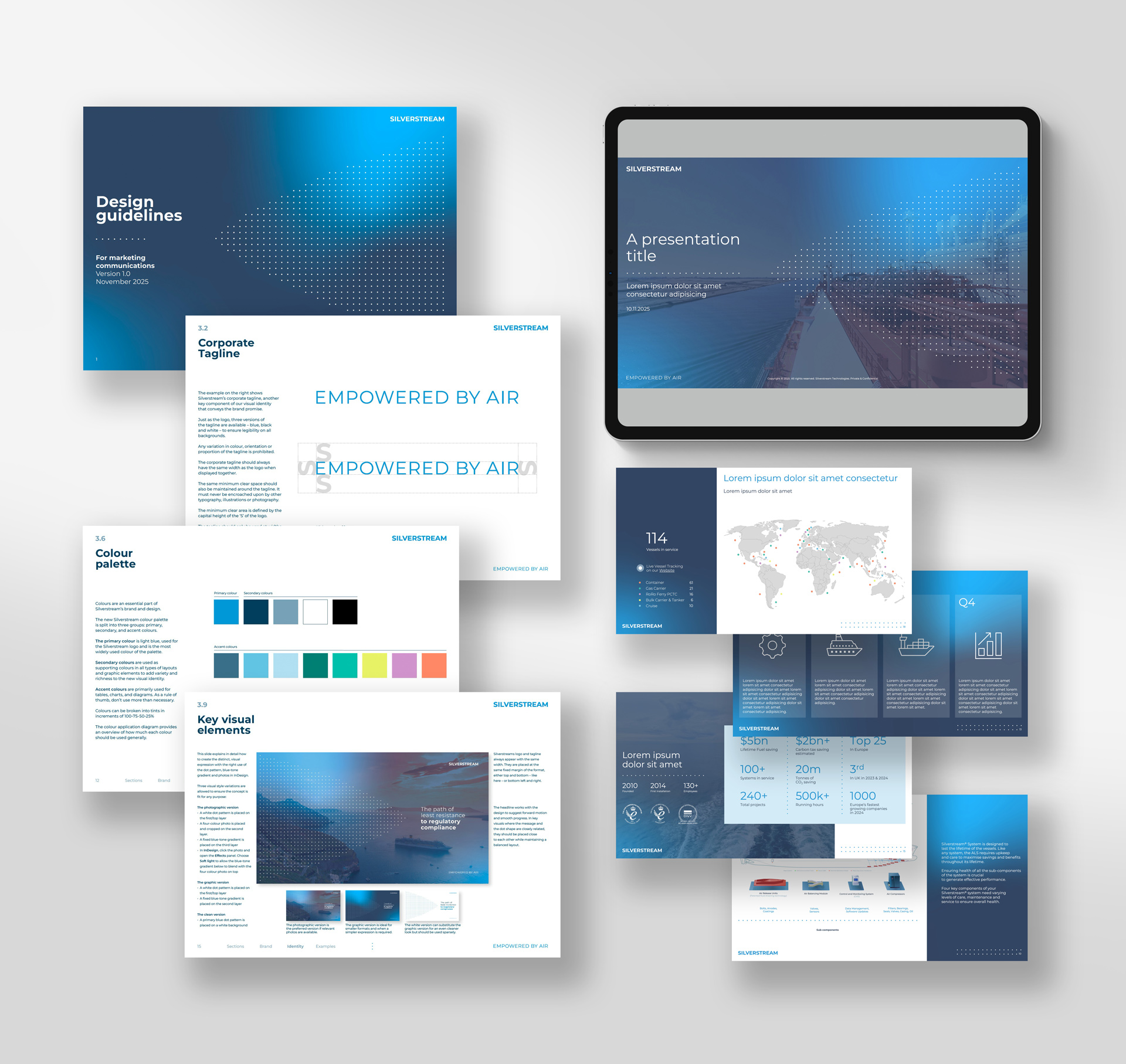
The solution. CBC moved the positioning from technology-driven to impact-driven, building a brand platform around measurable customer impact and industry leadership. The work covered a new logo and tagline, Empowered by air, a communications concept, a scalable design system and brand guidelines, so the message holds across every commercial conversation.
Frequently asked questions
What does rebranding mean?
Rebranding means changing how a company is perceived, not just how it looks. It typically covers positioning, value proposition, messaging and visual identity, and sometimes the company name.
How is B2B rebranding different from B2C?
B2B brands are chosen by groups of decision-makers over long buying cycles, so a B2B rebrand must give each stakeholder a clear reason to trust you and give sales a story they can use.
What’s the difference between rebranding and repositioning?
Repositioning changes what you stand for and where you compete. Rebranding usually includes repositioning, but also changes your story and identity so buyers can see the change.
Should you rebrand after an acquisition?
Often, yes, and early. A clear, shared brand helps customers, employees and partners understand what the combined company stands for.
Why work with a B2B-specialist agency on a rebrand?
Because B2B brands are bought differently. Most agencies split their focus between B2B and B2C; a specialist spends every day with long buying cycles, technical products and buying centres, which means less time learning your world and more time improving how it sees you.
Looking to rebrand for lasting value?
Rebranding is far more than a visual identity job. It’s a strategic process that touches every aspect of a business, from internal culture to customer perceptions.
A successful brand transformation requires getting the company’s mission, vision and values in sync with its goals, engaging stakeholders, and crafting a compelling narrative that truly engages audiences.
If your B2B organisation is considering rebranding, our experienced team can help ensure you go more than skin deep, delivering the rebranding that enables you to build lasting value. Feel free to contact me, Ralph Krøyer, at rk@cbc.dk or on +45 35 25 01 60 for a no-obligation chat.
About the author
Ralph Krøyer is Managing Partner at Cross-Border Communications (CBC), where he leads a senior international B2B team. He helps international B2B businesses make their value propositions clear and compelling, so they become the obvious choice – sharpening their position, standing out from competitors and turning brand and marketing into commercial growth. Explore CBC’s work with international B2B brands.
Sources
- McKinsey & Company, The surprising economics of B2B growth, May 2026


