Why producing more isn’t solving the B2B marketing content challenge
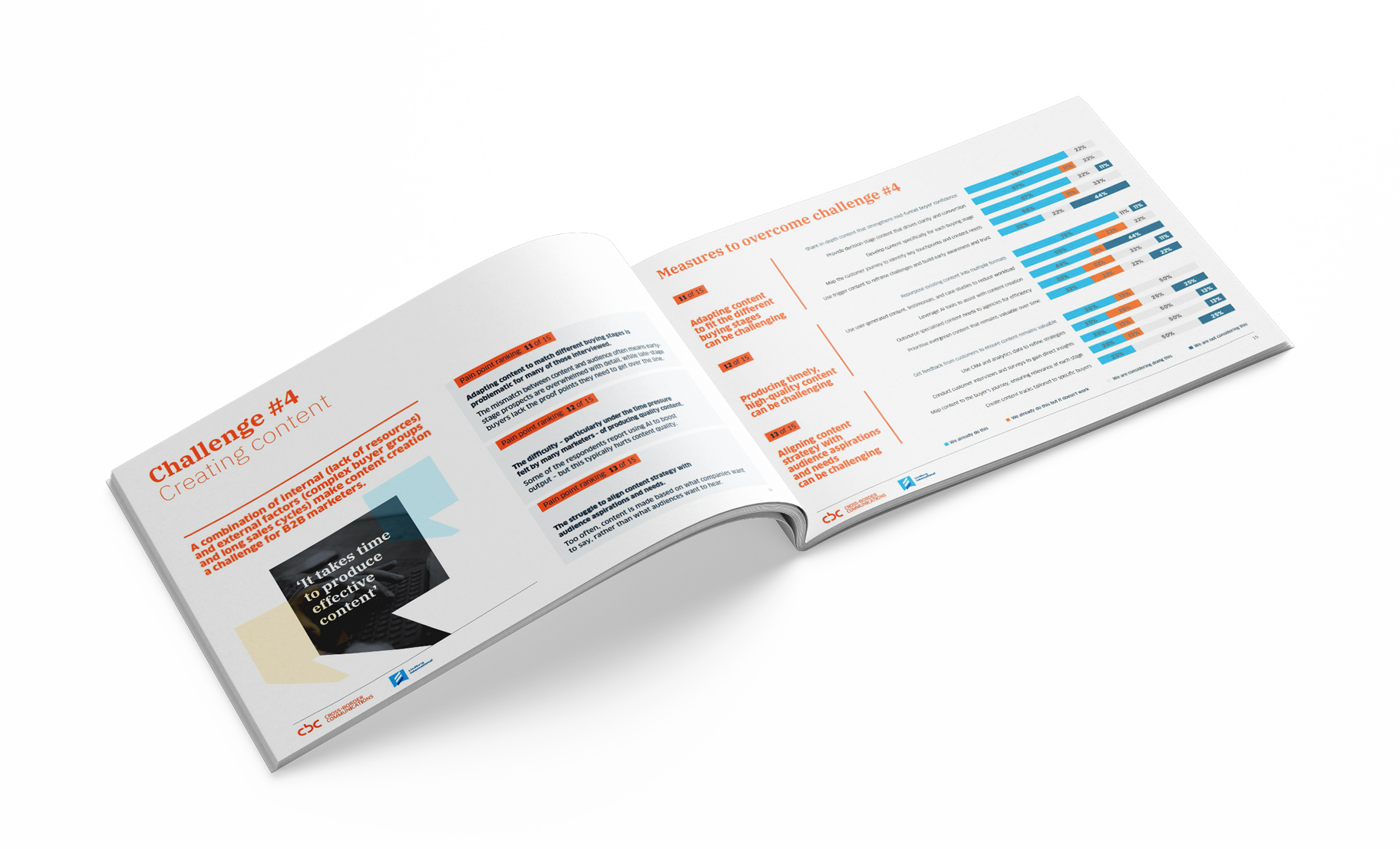
Developed in collaboration with Lindberg International, our survey of 20 CMOs from leading Danish B2B companies revealed the five core marketing challenges of 2026. This post looks at challenge number four: creating effective marketing content.

B2B marketing teams have produced content for years: white papers, articles, videos, case studies, sales decks. So it seems odd that ‘creating content’ shows up as a core challenge for 2026. But our CMO report frames it as a collision of pressures: limited resources on the inside, and complex buyer groups and long sales cycles on the outside. As the survey puts it, ‘it takes time to produce effective content.’
The difficulty, then, isn’t producing content. It’s producing the right marketing content, for the right stage, at consistent quality, with the resources most teams actually have.
The survey reveals that three pain points sit underneath the content challenge:
- adapting content to fit the different buying stages
- producing high-quality content under pressure
- aligning content strategy with audience aspirations and needs
Build the content plan into the marketing calendar
The most common problem is a mismatch between content and buying stage. Early-stage prospects get overwhelmed with detail, while late-stage buyers lack the proof points they need to close. Too often the asset is in the wrong format, arrives at the wrong moment, or simply doesn’t exist.
A marketing calendar tells you what’s going out and when, but not whether the whole buyer’s journey is covered. The answer isn’t a separate plan running alongside it: it’s building stage-by-stage mapping into the calendar itself, so it specifies which stage needs which asset, in which format.
Most B2B marketing teams are already moving this way. More than three-quarters share in-depth content to build mid-funnel confidence, and two-thirds develop content for each buying stage.
More B2B insights: How to stop information overload from killing B2B deals
Doing more with a small marketing team
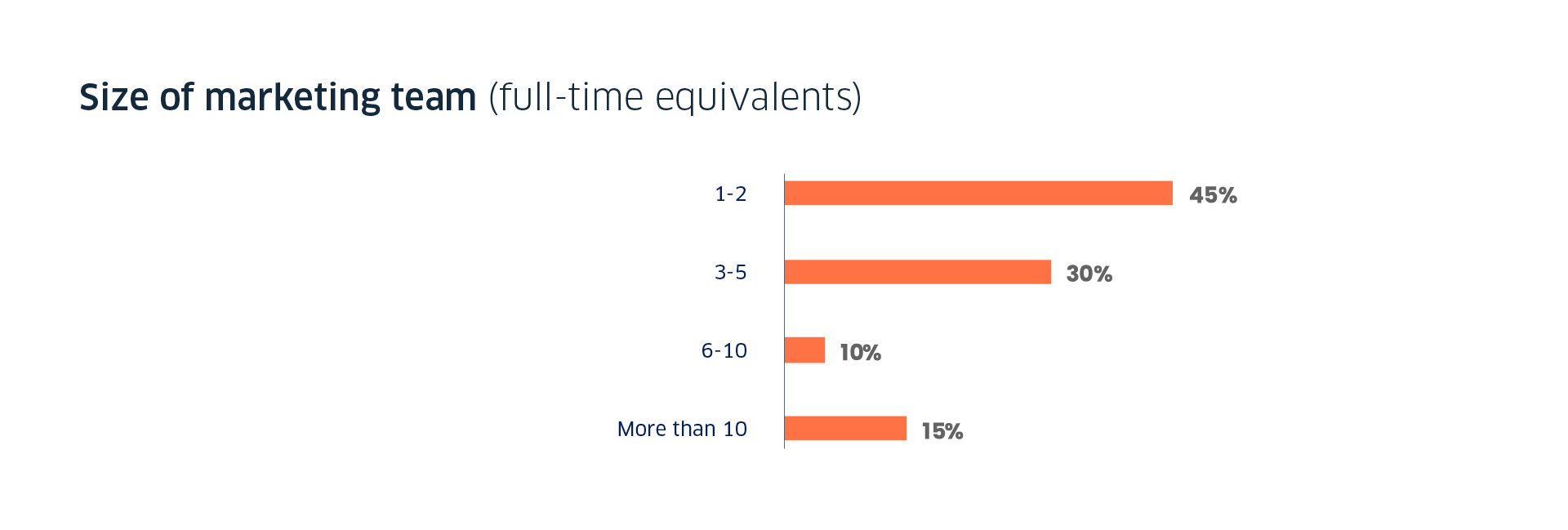
Producing high-quality content is where internal pressure bites hardest. Demand has never been higher, with more channels, formats, segments and markets to cover. Yet teams stay small: nearly half the companies surveyed have only one or two full-time marketers serving international markets.
Much of the raw material also sits with salespeople and technical experts who are, as the report notes, ‘always busy’, leaving marketing to fill the gap.
AI has gained ground, but B2B CMOs remain divided
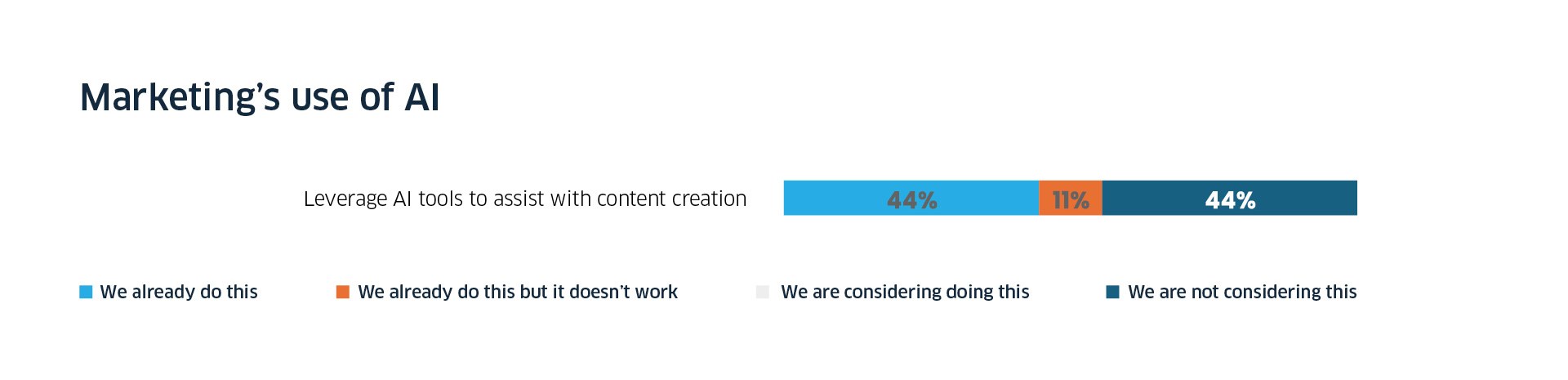
AI can ease resourcing pressure in small marketing teams while helping larger teams work faster and scale content production. Yet opinions remain sharply divided: 44% of those surveyed use it to generate content, while an identical share aren’t considering using it at all.
CMOs report that using AI speeds up drafting, repurposing and reformatting, yet they just as often flag that it can hurt quality. That’s the real tension: AI makes mediocre content cheap to produce, and mediocre content is exactly what audiences ignore. The insights, judgements and points of view that make content work aren’t things AI supplies on its own.
AI, in short, changes the economics of production without resolving the underlying challenge. Sure, it helps stretched teams hit volume targets. But without a clear content plan and real quality control, meeting those targets just produces more ineffective material.
Build marketing content once, reuse it across the B2B buyer’s journey
This is why the report’s main answer to the time squeeze isn’t ‘produce more’ but ‘reuse better’. Repurposing content into multiple formats is the most widely used efficiency tactic – adopted by more than three-quarters – alongside user-generated content, testimonials and case studies, evergreen pieces, and outsourcing specialised work to agencies.
None of these works well on its own, however. But together, they let a small team scale impact without scaling workload. For example: an evergreen piece reused across formats, a single case study serving both early awareness and late-stage validation, technical material adapted by role. Run them separately, and they just add to the team’s to-do list.
More B2B insights: Influencing the influencers: how stakeholder mapping drives better B2B marketing
Close the feedback loop to keep marketing content relevant
The third pain point quietly undermines the other two: content can end up reflecting what the company wants to say rather than what audiences want to hear. That’s less a messaging problem than a feedback one. It happens when teams get inadequate feedback on what actually works with their audiences.
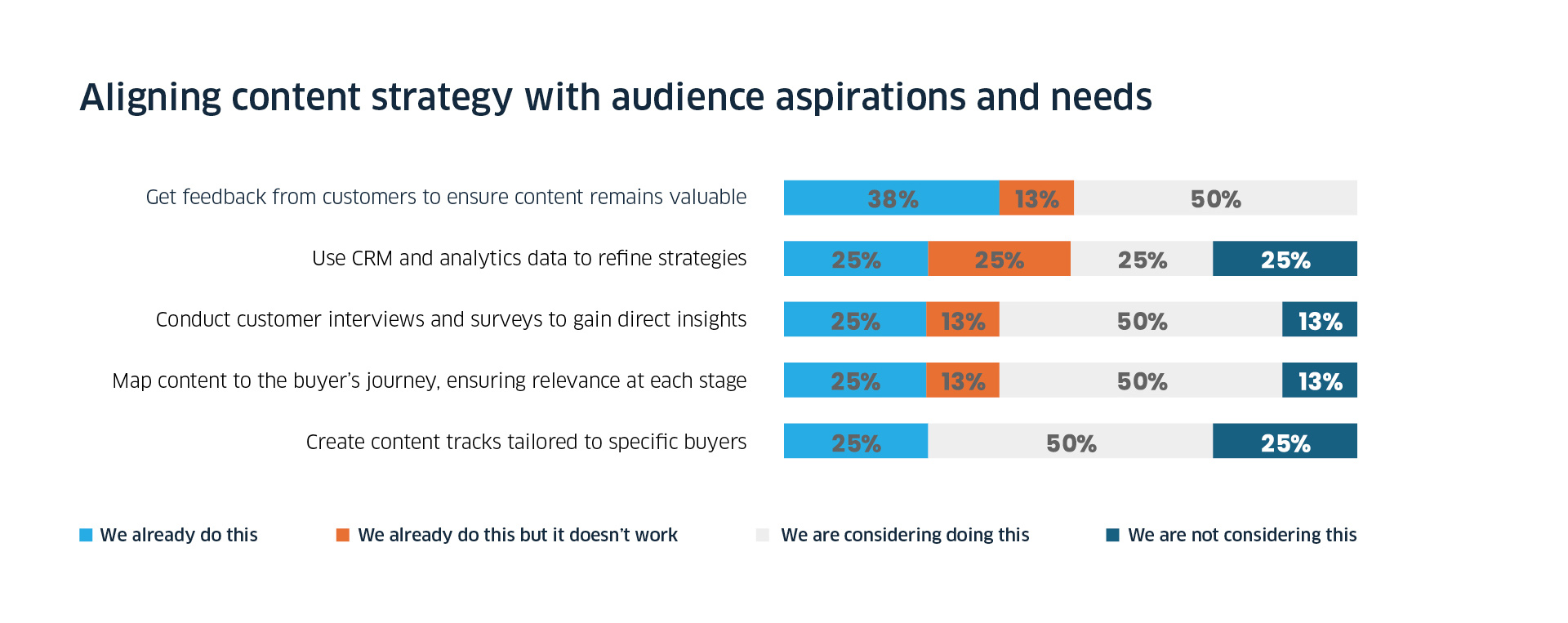
The measures that would close that loop are also the least adopted. Just over a third of those surveyed gather direct customer feedback; only a quarter use CRM and analytics data, run customer interviews, or build buyer-specific content tracks. Marketing content stays relevant when listening is designed into the process, not added on afterwards.
Content as a B2B marketing asset, not a production line
In 2026, the marketing edge won’t go to the teams publishing the most. It will go to those with a repeatable way of getting the right content to the right buyer: holding quality under resource pressure, putting AI to work without diluting it, and staying relevant through a built-in feedback loop. Get that right, and marketing content stops being a treadmill and instead becomes a genuine marketing asset.
More B2B insights: Quality B2B content is crucial. Why do so many companies get it wrong?
Interested in the full CMO report – or in continuing the conversation
To learn more, contact CBC Managing Partner Ralph Krøyer and ask to receive the full CMO report, with further insights and stats on challenge #4 plus the four other key B2B marketing challenges of 2026. You can reach him at rk@cbc.dk or +45 35 25 01 60.